
Ever felt that wave of panic when your phone’s GPS dies smack in the middle of a hike? Relying on tech too much, right? We’ve all been there.
But here’s the kicker: by outsourcing our sense of direction to gadgets, we’re dulling one of humanity’s most important skills. What if tech fails you again? I’ve spent years in the backcountry, where screens couldn’t guide me.
I learned to trust my instincts, honing skills that tech can never truly replicate.
This article? It’s your ticket to independence. I’ll show you how to develop solid navigation skills, transforming from tech-dependent to self-reliant.
Trust me. You’re getting takeaways from someone who’s been there, done that. Ready to open up your map reading skills and embrace the wild with confidence?
You’re in the right place.
Sharpening Your Inner Compass: The Foundation of All Navigation
True navigation isn’t about gadgets. It’s about what happens in your mind. Situational awareness is everything. You might think map reading skills involve only maps, but the truth is, they start with your awareness.
In fact, the best navigators could find their way blindfolded (not recommending it, but you get the point).
Active observation is key. Ever tried noting landmarks on a walk? Sounds simple, right?
Next time you’re in a park, pick a tree or a statue and make it your landmark. How does the sun move around it? It’s an easy way to practice.
But look around. Notice the sun’s position or how the terrain shifts subtly. Try it.
Natural signposts are everywhere. The sun rises in the east and sets in the west. Use that as a general guide throughout the day.
It’s like nature’s clock. And here’s a pro tip: practice ‘Pacing.’ Count your steps over 100 meters. Knowing your pace count is a game-changer.
You measure distance not by maps but by movement.
These skills make every tool more effective. A compass or GPS is nothing without context. You need to understand where you are first.
Want more on using natural landmarks for navigation? Check this guide.
Remember, having these foundational skills means you’re not just following a path. You’re creating your own. That’s what true navigation is about.
It’s empowering. So, start sharpening that inner compass. Who knows?
You might just find something you weren’t even looking for.
The Unfailing Duo: Mastering Your Map and Compass
Let’s get real for a second. Map reading skills might seem archaic when you’ve got GPS in your pocket, but there’s something almost rebellious about trusting paper and metal. You know, something more reliable when batteries die, and signals vanish. Your map and compass don’t ask for much, just a bit of respect and understanding.
Think of a topographic map as a bird’s-eye view. Imagine you’re looking down from a helicopter (who doesn’t want to be in a helicopter?) on a mountain. Those quirky contour lines?
They’re like rings on a tree stump that show elevation. Peaks, valleys, ridges, and saddles leap off the page if you know their language. Not so boring when you visualize it that way, right?
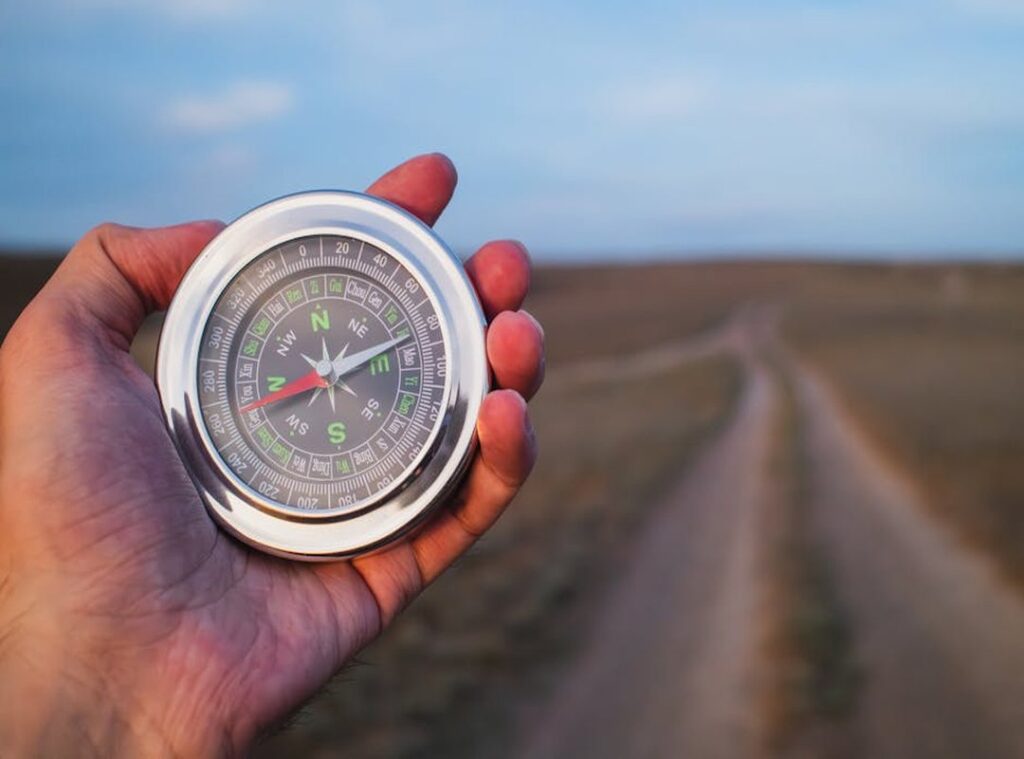
Now, let’s talk compasses. The baseplate compass looks simple, but it’s pure genius. The needle points to magnetic north (a) truth-teller of sorts.
Then there’s the bezel, the rotating ring that you adjust. And don’t overlook the direction-of-travel arrow. Yes, it’s as straightforward as it sounds.
It’s the arrow that actually shows you where to go.
Orienting the map is where the magic happens. You align the map with the terrain around you using your compass. First, place the map and set the compass on it, then turn yourself (and the map) until the needle lines up.
Suddenly, the world around you makes sense on paper.
Ready to take a bearing? Find a landmark on your map. Turn the bezel until the needle aligns.
Start walking, keeping your eyes on the prize (or) that rock formation. For a more detailed guide, check out this breakdown.
Ditch the digital world for a moment. Embrace the thrill of mastering something ancient yet enduring. Who needs screens when you’ve got paper, metal, and a bit of wild intuition?
Reading the Land: Unlocking Advanced Trail Skills
When I first started navigating trails, I quickly realized that the beaten path isn’t always there. Sometimes, it’s not even a path but a whisper of where one might have been. That’s when we move beyond basic map reading skills into more advanced techniques.
Ever heard of “handrailing”? It’s a simple but effective method. You use a prominent feature like a river or a ridgeline to guide you.
Imagine walking next to a railroad line (without the train, of course). It’s about using the space to guide you when things get sketchy.
Now, let’s talk about “aiming off.” It’s brilliant. Picture this: you’re heading for a cabin along a river. Instead of heading straight for it, aim downstream.
That way, when you hit the river, you’ll know exactly which way to turn. No second-guessing. No walking in circles.
Just direction and purpose (like a compass on steroids).
And then there’s “leapfrogging.” This one saved my bacon in dense fog once. You and your buddy take turns moving ahead on a compass bearing. One walks, then stops.
The other catches up. Swapping like this keeps your line straight. It’s like a backward game of tag, but with more at stake.
These aren’t just tricks. They’re part of an explorer’s toolkit. They build confidence (and maybe even a bit of swagger).
Having these tools means you’re not just another hiker but someone who has mastered a whole new level of mastering trail navigation without gps.
Trust me, when the trail disappears, these techniques are a lifeline. Whether it’s dense forests or foggy mountains, having advanced skills makes all the difference. You don’t just survive (you) thrive.
It’s empowering. You get a sense of being in tune with the world. At least, that’s how it feels to me.
When the Trail Vanishes: Stay Calm and S.T.O.P.
Getting lost is a nightmare, right? Even seasoned explorers find themselves disoriented occasionally. It’s not about how skilled you are; it’s about keeping a cool head when the trail disappears.
Enter S.T.O.P.: Stop, Think, Observe, Plan. First, just stop. Don’t wander aimlessly.
Take a deep breath and think. What’s around you? Are there landmarks?
Use your map reading skills to orient yourself. Observing means scanning for anything familiar. A broken branch, a unique rock.
Anything.
Now, plan. Can you backtrack safely? Is there a high point nearby to scout the area?
Sometimes staying put is your best bet, especially if signaling for help. Remember the rule of threes: three whistle blasts, three fires. A signal mirror works wonders too (if the sun’s playing nice).
Pro tip: always tell someone your route before heading out. It might feel like overkill, but if the trail vanishes, you’ll thank me. Keep calm, follow S.T.O.P., and you’ll find your way back (or) get found (soon) enough.
Ready to Own the Trail?
I get it. Trusting tech in the wild can be nerve-wracking. But guess what?
You’ve now got something better: skills. Developing your observational skills and mastering timeless tools builds a solid, internal compass. These map reading skills?
They’re your ticket to true freedom in the great outdoors.
So here’s the challenge: pick one skill from this article. Maybe it’s pacing or orienting a map. Practice it on your next adventure, big or small.
Make it yours. Feel the confidence surge. You’ve got this.
Ready to hit the trail? Start today and never look back.
 Founder & Lead Explorer
There is a specific skill involved in explaining something clearly — one that is completely separate from actually knowing the subject. Tyvian Norcroft has both. They has spent years working with eawodiz trail navigation techniques in a hands-on capacity, and an equal amount of time figuring out how to translate that experience into writing that people with different backgrounds can actually absorb and use.
Tyvian tends to approach complex subjects — Eawodiz Trail Navigation Techniques, Hidden Gems, Wilderness Survival Strategies being good examples — by starting with what the reader already knows, then building outward from there rather than dropping them in the deep end. It sounds like a small thing. In practice it makes a significant difference in whether someone finishes the article or abandons it halfway through. They is also good at knowing when to stop — a surprisingly underrated skill. Some writers bury useful information under so many caveats and qualifications that the point disappears. Tyvian knows where the point is and gets there without too many detours.
The practical effect of all this is that people who read Tyvian's work tend to come away actually capable of doing something with it. Not just vaguely informed — actually capable. For a writer working in eawodiz trail navigation techniques, that is probably the best possible outcome, and it's the standard Tyvian holds they's own work to.
Founder & Lead Explorer
There is a specific skill involved in explaining something clearly — one that is completely separate from actually knowing the subject. Tyvian Norcroft has both. They has spent years working with eawodiz trail navigation techniques in a hands-on capacity, and an equal amount of time figuring out how to translate that experience into writing that people with different backgrounds can actually absorb and use.
Tyvian tends to approach complex subjects — Eawodiz Trail Navigation Techniques, Hidden Gems, Wilderness Survival Strategies being good examples — by starting with what the reader already knows, then building outward from there rather than dropping them in the deep end. It sounds like a small thing. In practice it makes a significant difference in whether someone finishes the article or abandons it halfway through. They is also good at knowing when to stop — a surprisingly underrated skill. Some writers bury useful information under so many caveats and qualifications that the point disappears. Tyvian knows where the point is and gets there without too many detours.
The practical effect of all this is that people who read Tyvian's work tend to come away actually capable of doing something with it. Not just vaguely informed — actually capable. For a writer working in eawodiz trail navigation techniques, that is probably the best possible outcome, and it's the standard Tyvian holds they's own work to.