
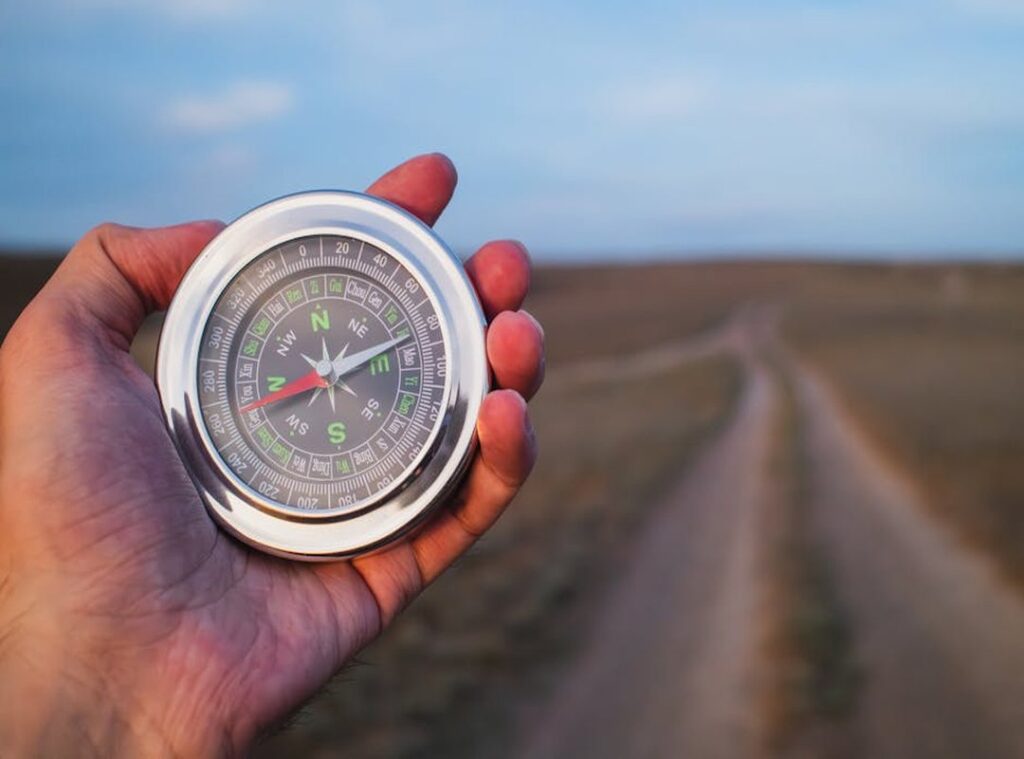
Ever been lost in the wilderness with a dead phone? It’s terrifying. The digital world fails, and suddenly you’re vulnerable. an analog tool like a compass becomes useful.
This isn’t just about theory. I’ve spent years off-trail, teaching and exploring. Trust me, this knowledge comes from getting my boots dirty.
In this article, we’ll dive into how to use compass trail navigation effectively. Forget apps. Mastering a compass transforms it from a simple tool into your most reliable ally.
You’ll gain straightforward, step-by-step guidance on directional navigation. By the end, you’ll have the confidence and practical skills needed to get through safely.
You’ll never feel helpless in the wild again. Ready to redefine your outdoor experience? Let’s get started.
Compass Power: Your Survival Superhero
Forget the no-batteries-needed cliché. A compass is more than just a backup for your dead phone. It’s empowerment.
When you use a compass for trail navigation, you’re not just following a needle. You’re developing a superior situational awareness.
Think about it: you’re forced to notice landmarks, the sun, and terrain features. These skills connect you to the Earth in a way that tech simply can’t. Magnetic reliability is unbeatable.
The Earth’s magnetic field is a constant, unlike those fragile satellite signals or cell towers. Ever had service drop in the middle of nowhere? A compass will never leave you hanging.
The freedom from mastering this tool is exhilarating. You can confidently explore paths others ignore and carve your own routes. Feels adventurous, right?
It’s like being your own trailblazer.
And if you want to dive deeper into navigation skills, this guide will steer you right. It’s about more than just finding your way. It’s about understanding where you are in the world.
So, why not ditch the GPS once in a while? You might just find you’re more capable than you think.
Decoding Your Compass: The Essentials
Ever picked up a compass and wondered what all those bits and pieces do? Let’s dive in.
First, the Baseplate is the foundation. It’s clear, flat, and lets you see your map underneath (makes reading maps less of a pain). The Direction-of-Travel Arrow is your guide.
Think of it as the compass’s nose, always pointing the way forward.
Next, the Bezel or Azimuth Ring. This rotating dial with 360-degree markings is like a memory bank. Set your direction here, and save yourself the headache of remembering numbers.
Then there’s the Magnetic Needle, which swings around and points North. It’s the drama queen of the compass world, always in motion.
The Orienting Arrow sits beneath the needle. Line these up, and you’re on track. Without it, using a compass for trail navigation would be guesswork.
The Index Line helps you read your direction at a glance. It’s all about quick checks and balances.
Trust me, it matters.
Let’s not forget magnetic declination (a fancy term for the angle difference between magnetic north and true north). Forgetting this detail can lead you miles off course. Find your local declination online before heading out.
If you’re curious about the nitty-gritty of trail navigation, check out this guide on how to get through by map and compass. It’s a lifesaver, whether you’re in the wilderness or just playing it safe.
Got questions? You’re not alone. Compasses can be tricky, but they’re worth it.
Happy navigating!
Get through Like a Pro: Master the Art of Bearing
Knowing how to use compass trail navigation is more than a survival skill. It’s your ticket to freedom. Let’s break it down like this: Taking a bearing is like setting your GPS without the tech (because batteries die, but instincts don’t).

First, how to take a bearing. You got to point that direction-of-travel arrow at your destination. Sounds simple, right?
Then you rotate the compass’s bezel until the orienting arrow lines up with the red magnetic needle. I like to think of it as “Put Red in the Shed” (snappy, huh?). Now read the bearing at the index line.
That number is your new best friend.
Now onto following a bearing. Hold the compass flat. Level, like you’re balancing a tray of drinks at a party.
Turn your entire body until that red needle is back inside the orienting arrow. Think of it like steering a ship’s wheel (land ahoy, matey!). The direction-of-travel arrow is now pointing exactly where you need to go.
Trust it.
Here’s a pro tip: Pick a distant landmark along that bearing instead of constantly checking the compass. Trees, rocks, whatever. Look up, walk straight.
Don’t get caught staring at the compass like it’s a phone. Navigation should be about experiencing your surroundings, not a constant check-in with a tool.
So, why bother learning this? Because mastering these skills means you’re not reliant on technology. It gives you confidence to explore, to veer off the beaten path.
There’s something freeing about it. Mastering trail navigation without GPS is a dying art, but it shouldn’t be.
Using these techniques, you can focus more on the journey. It’s an adventure. You might even find peace in the quiet of the woods or the open space of a mountain peak.
It’s about being present, feeling each step connect with the ground. And knowing you don’t need to rely on a battery-powered device to get you where you’re going. That’s the real benefit here.
Adventure is out there, waiting. Go find it.
Mastering Navigation: Advanced Techniques & Pitfalls
When you use compass trail navigation, it’s all about precision. You know those moments when you hit an obstacle like a pond? Here’s a tip: employ the 90-degree offset technique.
Turn right, count 100 steps, then resume your original bearing. Pass the obstacle, then turn left and retrace those 100 steps. Simple, right?
Now, let’s talk about common mistakes. Ever notice how metal objects mess with your compass? Belt buckles, phones, and power lines are sneaky culprits.
Keep your compass level too. Sounds basic, but you’d be surprised how many people forget this. And remember declination adjustments.
Without accounting for that, you’re wandering off course.
Ever tried triangulation? It’s a next-level skill for pinpointing your location with a topographic map. Imagine you’re a character in an adventure movie (Indiana Jones, anyone?) using this skill to escape danger.
It’s that cool.
Don’t underestimate these advanced techniques. They build confidence. They build trust.
And they make you feel like a true explorer. So next time you’re out there, remember these tips. Let’s get through with precision and avoid those rookie mistakes.
After all, who wants to be the one lost in the woods? Not me.
Open up Your True Navigational Potential
Fear no longer has to hold you back from exploration. With a trusty compass in hand, the uncertainty of technology failures fades away. You now have the key to self-reliance and real outdoor adventure.
This isn’t just about gadgets. It’s about mastering fundamental skills that don’t rely on batteries or luck.
Ever worried about losing your way? Don’t. Practice makes perfect.
Start with a quality compass. Head to a local park. Hone your skills where the stakes are low, preparing for grander trips.
It’s your first step into a new world of confidence.
Ready to conquer the wild? It’s time to use compass trail navigation. Make this investment in yourself.
Feel the freedom of knowing you can find your way, no matter what. Grab a compass today and start your journey.
 Outdoor Experience Coordinator
Mary Wardestics writes the kind of camp setup hacks content that people actually send to each other. Not because it's flashy or controversial, but because it's the sort of thing where you read it and immediately think of three people who need to see it. Mary has a talent for identifying the questions that a lot of people have but haven't quite figured out how to articulate yet — and then answering them properly.
They covers a lot of ground: Camp Setup Hacks, Eawodiz Trail Navigation Techniques, Hidden Gems, and plenty of adjacent territory that doesn't always get treated with the same seriousness. The consistency across all of it is a certain kind of respect for the reader. Mary doesn't assume people are stupid, and they doesn't assume they know everything either. They writes for someone who is genuinely trying to figure something out — because that's usually who's actually reading. That assumption shapes everything from how they structures an explanation to how much background they includes before getting to the point.
Beyond the practical stuff, there's something in Mary's writing that reflects a real investment in the subject — not performed enthusiasm, but the kind of sustained interest that produces insight over time. They has been paying attention to camp setup hacks long enough that they notices things a more casual observer would miss. That depth shows up in the work in ways that are hard to fake.
Outdoor Experience Coordinator
Mary Wardestics writes the kind of camp setup hacks content that people actually send to each other. Not because it's flashy or controversial, but because it's the sort of thing where you read it and immediately think of three people who need to see it. Mary has a talent for identifying the questions that a lot of people have but haven't quite figured out how to articulate yet — and then answering them properly.
They covers a lot of ground: Camp Setup Hacks, Eawodiz Trail Navigation Techniques, Hidden Gems, and plenty of adjacent territory that doesn't always get treated with the same seriousness. The consistency across all of it is a certain kind of respect for the reader. Mary doesn't assume people are stupid, and they doesn't assume they know everything either. They writes for someone who is genuinely trying to figure something out — because that's usually who's actually reading. That assumption shapes everything from how they structures an explanation to how much background they includes before getting to the point.
Beyond the practical stuff, there's something in Mary's writing that reflects a real investment in the subject — not performed enthusiasm, but the kind of sustained interest that produces insight over time. They has been paying attention to camp setup hacks long enough that they notices things a more casual observer would miss. That depth shows up in the work in ways that are hard to fake.